
Wrapping up 2025, building 2026
Wrapping up 2025, building 2026
From consolidating principles into real systems in 2025 to building sovereign, transparent, and human-aligned AI infrastructure in 2026.

Product Writer
As 2025 comes to an end, it feels less like a conclusion and more like a point of consolidation. This has been a year of making ideas tangible, of turning principles into systems, and of proving that another way of building AI is not only possible, but already working in the real world.
At Empathy.ai, we have spent the past year refining a clear stance: AI should be understandable, inspectable, transparent, private by design, and aligned with human values. Not because it is fashionable to say so, but because the infrastructure choices we make today will define how people interact with technology for years to come.
This post looks back briefly at what 2025 helped us solidify, and then looks forward to what we are deliberately building in 2026.
2025: From ideas to operating reality
Turning intent into meaningful experiences
Throughout 2025, we focused on rethinking how people interact with search, discovery, and information. Features like Related Prompts, AI Overview, Conversational Analytics, and experimental assistants such as the chat widget for Motive and Truman for CasaDelLibro demonstrated a consistent idea: search should move beyond keyword matching and become an intent-aware, meaningful interaction.
These experiences showed that generative AI can be used without turning the multiple applications of generative AI into black boxes. AI can summarize, guide, and propose the best option and enhanced alternatives while remaining grounded in real catalog data, governed logic, and explainable behavior. The result is not automation for its own sake, but clarity for both shoppers and teams.
Privacy, governance, and infrastructure as product decisions
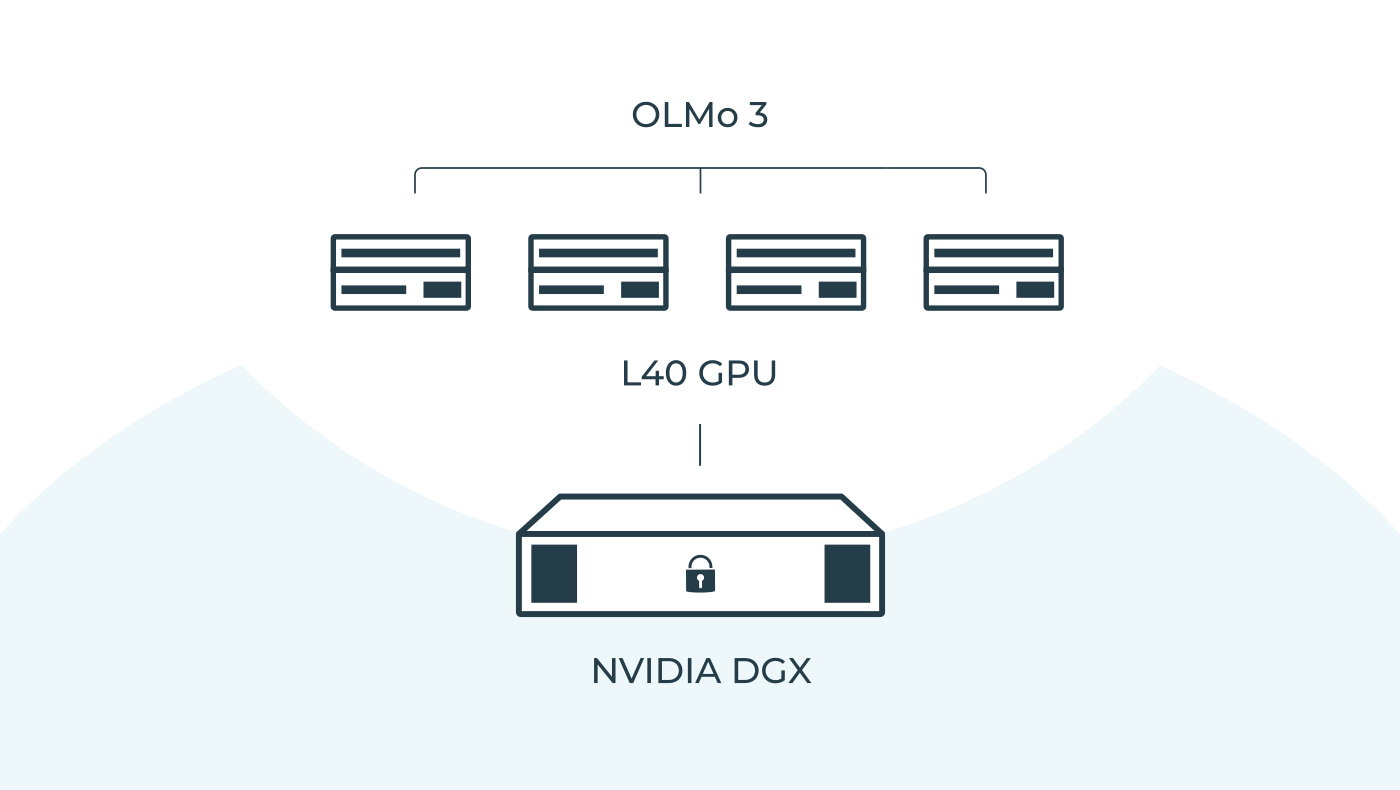
Another defining moment of 2025 was making AI compute infrastructure visible as a product choice. By investing in private, self-hosted AI cloud, powered by dedicated GPUs and supported by sustainable energy sources, we demonstrated that performance, privacy, and responsibility are not trade-offs.
Owning the infrastructure where our AI experiments, demos, and productized developments run, allowed us to reduce dependency, improve latency, enforce strict data governance, and keep AI workloads within local boundaries. It also reinforced the belief that AI should not be rented blindly from opaque systems, but built and operated where accountability lives.
Experimentation as a way to think in public
Projects like BringTheBookToLife, inspired by Project Gutenberg, and collaborations in book discovery and conversational search, like Truman, highlighted the importance of open experimentation. Using public data, open-weight models, and self-hosted systems, we explored how AI could assist discovery without pretending to be human or extracting personal data. All of this resulted in Truman, a productized AI assistant that provides advice on the book best suited to readers’ needs and aims, while simultaneously summarizing the author’s works or giving descriptions of sagas and other related data.
These initiatives were not proof of scale, but proof of direction. They helped shape the questions we want to keep asking.
2026: Building with intention and momentum
If 2025 was about consolidation, 2026 is about commitment. The year ahead is not about adding features indiscriminately, but about deepening the foundations that allow AI to remain useful, ethical, and resilient over time.
1. Doubling down on sovereignty, privacy, and sustainability
Our foremost priority for 2026 is to continue strengthening our private AI compute infrastructure.
This means expanding our in-house GPU capacity, keeping AI workloads physically local, and ensuring that customer data never leaves controlled environments. AI sovereignty is not an abstract concept for us. It is a practical response to a fragile ecosystem increasingly dependent on third-party providers, shared infrastructure, and opaque decision-making.
By scaling a local infrastructure, we aim to offer organizations a clear alternative: advanced AI capabilities without sacrificing control, compliance, or long-term stability. In 2026, AI should behave more like a solid infrastructure and less like a subscription. Something organizations own, understand, and can rely on.
Sustainability remains a core constraint, not an afterthought. Energy efficiency, responsible computation, and transparent resource usage will continue to guide our growth.
2. Defending the de-anthropomorphisation of AI
One of the most important positions we will continue to defend is the de-anthropomorphisation of AI.
This belief is central to our role as executive producers of Molly vs. the Machines, an investigative documentary and experiential project that exposes how engagement-driven algorithms shape behavior, extract attention, and exploit vulnerability, often without regard for the impact on mental health or long-term consequences.
The machine experience behind Molly vs. the Machines is intentionally uncomfortable. It does not empathize. It does not console. It does not pretend to understand grief or emotion. Instead, it reveals structure, incentive, and consequence. It speaks with you, but never for you.
This distinction matters. When AI systems are portrayed as emotional entities, users are encouraged to trust, confide in, and defer to them. When AI is presented as what it truly is, a system built on data, incentives, and architecture, people retain agency.
In 2026, we will continue advocating for AI that is transparent about its nature. Machines should assist human thinking, not replace it. They should expose systems, not obscure them behind simulated empathy.
3. Advancing conversational and discovery-driven search
Search remains one of the most powerful interfaces between people and digital systems. In 2026, we will continue to bring AI capabilities into search by creating richer, more intuitive ways for shoppers to interact with catalogs.
This means expanding conversational search and discovery experiences that allow users to express their intent in natural language, even when they do not know what they are looking for. It also means designing interactions that guide rather than overwhelm, that offer alternatives rather than dead ends, and that turn low-results scenarios into meaningful exploration.
The goal is not to replace traditional search, but to augment it with layers of understanding, context, and dialogue that respect both the user and the underlying data.
4. Making systems explainable through MCP agents
Another key focus for 2026 is the continued development of Model Context Protocol (MCP) agents.
MCP agents allow natural-language conversation applications to connect directly with live analytics, configurations, and other tools and features. Instead of navigating complex insights dashboards or trying to understand and apply opaque business rules and configurations, teams can ask questions, explore outcomes, and understand cause and effect through dialogue.
This transforms analytics and search configuration into something explainable and interactive. Merchandisers gain clarity about why systems behave the way they do. Adjustments become intentional, traceable, and reversible.
In a landscape where systems must evolve quickly, MCP enables more efficient, loosely coupled connections between tools, features, and data sources. This architecture allows teams to adapt fast, swap or update LLMs, and iterate without heavy dependencies, all while remaining fully transparent to customers. MCP’s value lies behind the scenes, empowering change without exposing complexity.
5. Making our own tools more intuitive and practical
Finally, in 2026, we will continue to simplify, clarify, and enhance our internal tools to better support human workflows.
Experiences like Empathy Platform Docs Search represent this direction. By applying generative understanding and semantic reasoning to documentation, EPDocs Search allows people to explore information through natural language, even when they do not know the exact terms or structure of the content.
This improves the information seeking experience for users, who can also receive contextual, grounded answers that reflect the actual documentation. This reduces friction, saves time, and lowers the cognitive burden associated with understanding complex product documentation.
Intuitive tools are not about hiding complexity. They are about revealing it gradually to make it accessible at the pace people need.
Looking ahead
As we enter 2026, our direction is clear. We are not chasing scale at any cost, nor novelty for its own sake. We are building AI systems that are sovereign, private, sustainable, and transparent about their capabilities.
Next year will be about reinforcing these foundations, expanding responsibly, and continuing to show that AI can be powerful without being extractive, useful without being deceptive, and advanced without losing sight of human values.
This is not the fastest path. But it is the one we believe will endure.