


Imagine AI operating without distant servers or fragile networks. Intelligence that runs quietly, responsibly, and entirely within an organization’s own walls. No outages, no external dependencies, no hidden cost of giving your data to someone else.
Now picture that same self-contained intelligence powered by renewable energy, running on the very sunlight that warms the building around it.
These questions are no longer hypothetical. They outline a shift that is already underway: a private-cloud, in-house AI that is resilient, sustainable, and grounded in open-source transparency. It is a shift driven not by hype, but by necessity.
The fragility of outsourced intelligence
Over the past months, we have seen how quickly entire ecosystems can be disrupted. A single outage in a global service provider has taken down AI tools around the world, stalling workflows, interrupting customer experiences, and revealing just how fragile our reliance on external infrastructure can be.
Even the biggest names in AI depend on services like Cloudflare to serve their models to millions of users. When that layer fails, every dependent service fails along with it. This vulnerability is not theoretical. It has already happened.
This raises a simple but profound question: If AI is becoming the new nervous system of organizations, why is it still hosted on infrastructure we do not control?
A different way forward: high-performance AI, hosted at home
Empathy AI’s approach begins with a straightforward premise: intelligence should live where the responsibility lies. That is why we are bringing AI in-house with NVIDIA DGX Spark supercomputers and a supporting architecture of L40 GPU servers. These systems no longer represent a luxury reserved for hyperscalers. They are becoming the backbone of private, sovereign, real-time intelligence.
Instead of pushing AI workloads into a public cloud where resources are shared, we run them locally, in a private environment powered by dedicated hardware. This creates a fundamentally different relationship with technology. Data stays inside. Latency drops. Uptime becomes something we control rather than something we hope for. And teams no longer depend on the licensing decisions or availability of external providers.
AI becomes infrastructure, not a subscription.
Each DGX Spark can host up to 128 isolated workspaces for teams to create, iterate, and experiment without escalating external licensing fees. That shift turns what would have become more than €130,000 per year in cloud AI costs into a one-time hardware investment that powers innovation, not dependency.
Open-source intelligence: the importance of OLMO3
This move toward independence is not only about hardware. It is equally about the kind of intelligence we choose to run.
Closed, proprietary models create a silent dependency: you cannot inspect them, you cannot adapt them freely, and you cannot detach them from the cloud providers that control them. Their training data is opaque, their constraints are unclear, and their long-term costs are unpredictable.
Open-source models, especially those designed for local deployment, break this cycle. At the center of this shift is OLMO3, the new open-source large language model from AllenAI.
OLMO3 represents a different philosophy: transparency instead of opacity, community instead of exclusivity, sovereignty instead of lock-in. Its architecture is designed for organizations that want to run AI privately, ethically, and sustainably.
By integrating OLMO3 into our private-cloud architecture, we gain the ability to deploy cutting-edge language understanding entirely on-site, without sending a single token to an external endpoint. Its open-source origins also mean no licensing barriers and no hidden obligations. It is intelligence that belongs to the organization running it.
Using OLMO3 is not simply a technical choice. It is an affirmation: AI should empower, not extract.
Sustainability: where computation meets sunlight
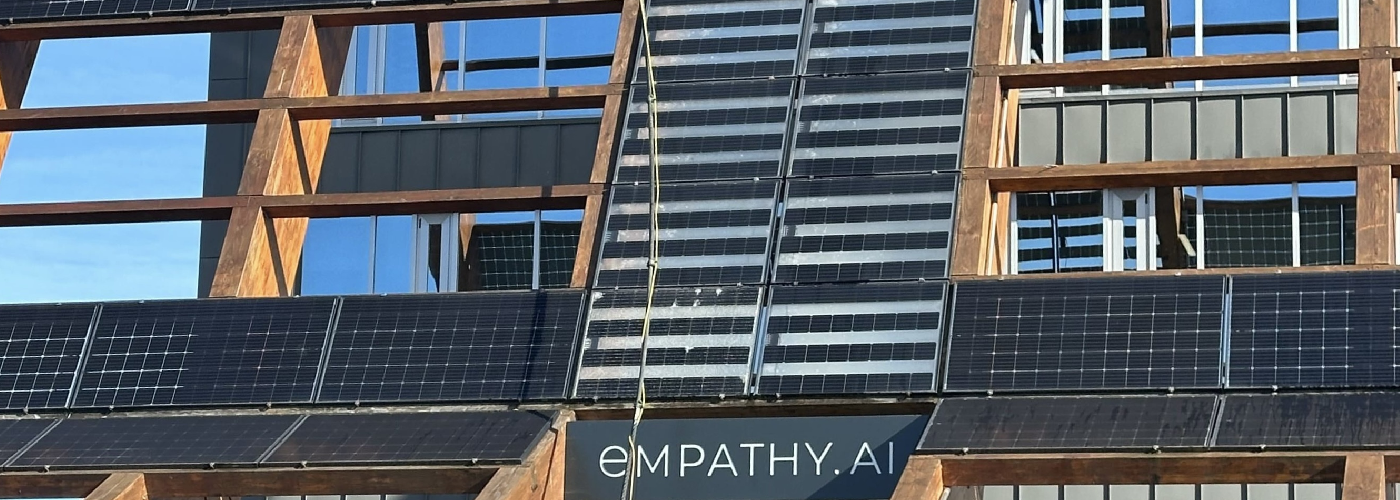
Perhaps the most overlooked advantage of in-house AI is the ability to power it responsibly. At Empathy AI, the DGX Sparks and L40 servers run in a net-zero energy bioclimatic building, where a solar installation supplies part of the computing power behind our private-cloud AI.
This matters for two reasons.
First, the environmental footprint of cloud-based AI is often invisible. As models grow, so does the energy demand required to run them across global data centers. That cost, environmental and ethical, is not something most organizations can measure, let alone influence.
Second, running AI locally enables a more transparent, accountable use of energy. When intelligence is hosted inside a building designed to generate a significant part of its own power, sustainability stops being an aspiration and evolves into an operational reality.
Energy and intelligence become intertwined in a new way: computation aligned with climate responsibility.

Uptime, sovereignty, and the quiet resilience of local computation
When AI is hosted externally, reliability becomes conditional. It depends on the stability of global networks, the uptime of third-party vendors, and the dependencies those vendors themselves rely on.
When AI is hosted internally, reliability becomes an architectural advantage. It depends on hardware that the organization owns, on systems it maintains, and on infrastructures designed for its specific needs and regulatory environment.
Consider the simplicity of this: If your AI lives inside your own walls, no outage thousands of kilometers away can interrupt it.
This is not just a technical upgrade. It is a philosophical one. It is the belief that intelligence should be as stable as the organization it serves.
The combination of DGX Spark supercomputers, L40 GPU servers, and open-source models like OLMO3 forms more than a new technical stack. It becomes a declaration about what AI should be.These principles are not optional add-ons. They form the foundation of responsible intelligence.
The horizon ahead
As organizations begin to understand the cost of dependency and the value of sovereignty, the path forward becomes clearer. AI must move closer to where decisions are made. It must respect the boundaries of data. It must run on infrastructures aligned with the planet, not strained against it. And it must be open, interpretable, and free from the constraints of proprietary ecosystems.
In-house AI is not a return to the past. It is a step toward a more deliberate, balanced future. A future where intelligence is an asset held, not a service rented.
The transition has already begun. The question now is not whether organizations should bring AI in-house, but what they will build once they do: systems that inspire trust, elevate teams, and put human values at the center of technological progress.
If you are imagining what this could look like for your industry or your organization, we are ready to explore it with you. The next era of AI is sovereign, sustainable, and open. And it is within reach.